



 56 / 108

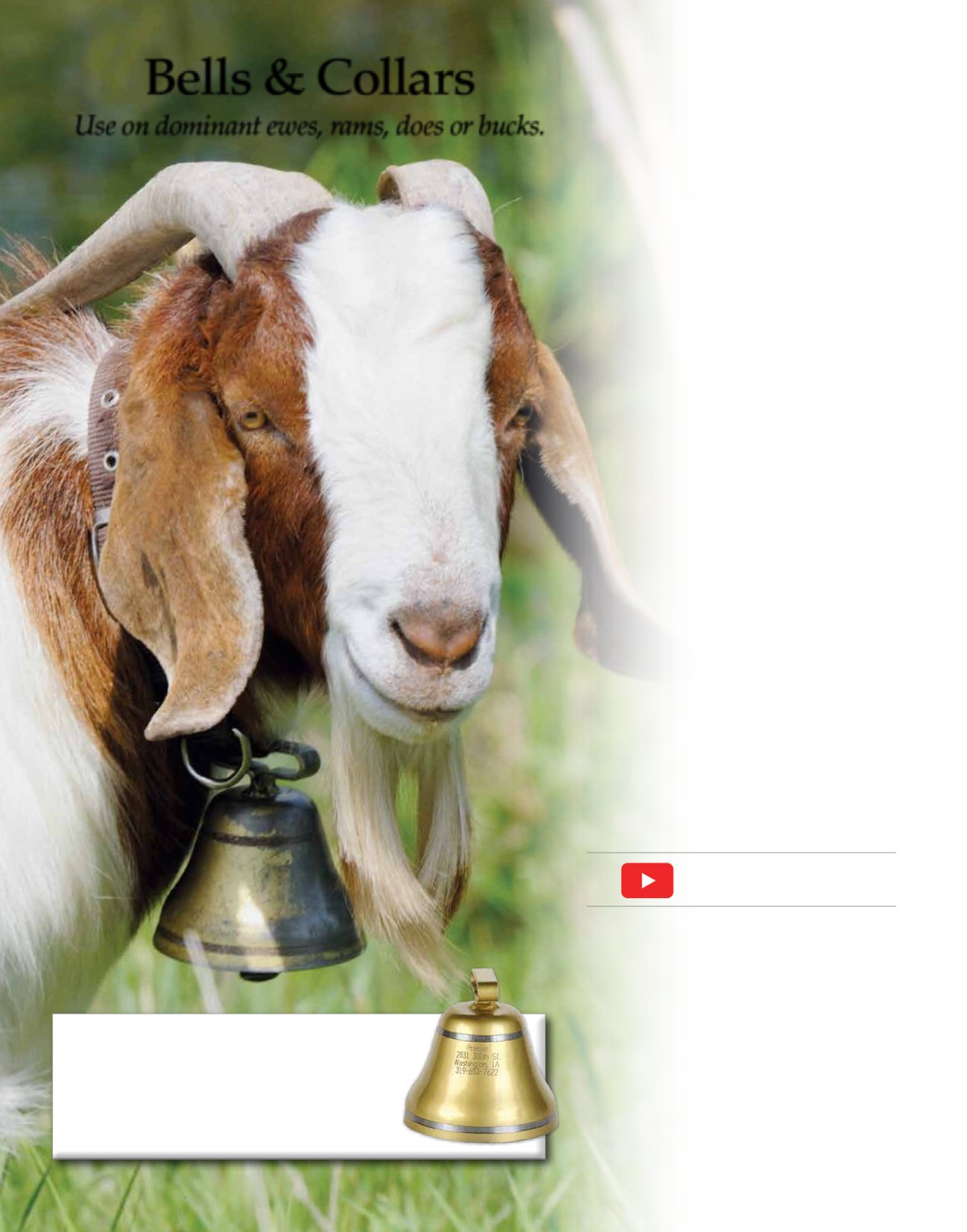 Ram/Billy Bell
Alerts you when pushy, territorial rams or billies
are nearby. Heavy-duty. 4"W x 3"H.
Can be laser imprinted up to 15 characters on 4 lines
(specify on order).
Ram Bell, 0.80 lb...........................................#615504 $9.00
Ram Bell, imprinted, 0.80 lb........................#615506 $12.00
Bell and collar
after one year of
intense use with
our Boer buck.
Ram/Billy Bell
Alerts you when pushy, territorial rams or billies
are nearby. Heavy-duty. 4"W x 3"H.
Can be laser imprinted up to 15 characters on 4 lines
(specify on order).
Ram Bell, 0.80 lb...........................................#615504 $9.00
Ram Bell, imprinted, 0.80 lb........................#615506 $12.00
Bell and collar
after one year of
intense use with
our Boer buck.
Benefits of Bells
We like the sound of bells echoing across the
pastures as the animals graze. We suspect you
too will find this to be uniquely pleasant.
In addition to pleasant tones, bells on grazing
animals have practical purposes:
• To facilitate locating the herd or flock.
Listening for the sound of the bells saves
time tracking them down.
• To provide assurance that they are still
where they should be.
• To give advance warning of charging
rams/bucks.
• To alert you if the herd or flock is startled
because the sound is, obviously, different.
• Users report that bells deter predators.
How do they do this?
The sound of a
bell is foreign to coyotes. It makes them
wary. When coyotes or wolves approach,
the increased sound from alarmed bell-
wearing animals will notify guard dogs and
shepherds that something is amiss.
Do we
use only bells to deter predators?
No—
we also use guard dogs and miles of
electrified fences.
Field experience—
Pete Arambel, co-owner of
The Shepherd
magazine, runs a flock of 6000 head in
Wyoming. He too uses bells—about 1 per
every 25 ewes. Pete says that bells go on ewes
after shearing.
Ewes new to bells dance around a little bit but
eventually become accustomed to them.
Perks?
When grazing forested areas it’s easier
to find sheep with bells than by sight.
Guardian dogs become accustomed to normal
bell tones. When a different sound is heard,
such as a ewe being threatened by a predator,
dogs immediately investigate.
Gordon Shelangoski (a Premier consultant)
uses bells on his flock as well. He notes that
“anything maintenance-free that makes a
predator nervous is worth doing.”
Bell maintenance—
If a bell is not “dinging” properly, check
the following:
• Broken clapper attachments.
• A “stuck” clapper.
• A bell that’s full of mud or grass.
Replacement clappers are available through
our website or by calling us at 800-282-6631.
How tight should the collar be?
You should be able to slide your hand
underneath the collar. If too loose, the collar
may come off.
56
premier1supplies.com • 1-800-282-6631 HEAR BELLS IN USE premier1supplies.com/videos Bells & Collars Use on dominant ewes, rams, does or bucks.