



 39 / 56

 www.premier1supplies.com • 1-800-282-6631
39
Q. Fence troubleshooting?
A.
Is the fence or energizer at fault?
1. Turn off the energizer and
disconnect it from the fence.
2. Turn the energizer back on and test
the terminals with a fence tester.
If the energizer reads less than 4000v,
the energizer (or its battery) is the
problem. If the tester
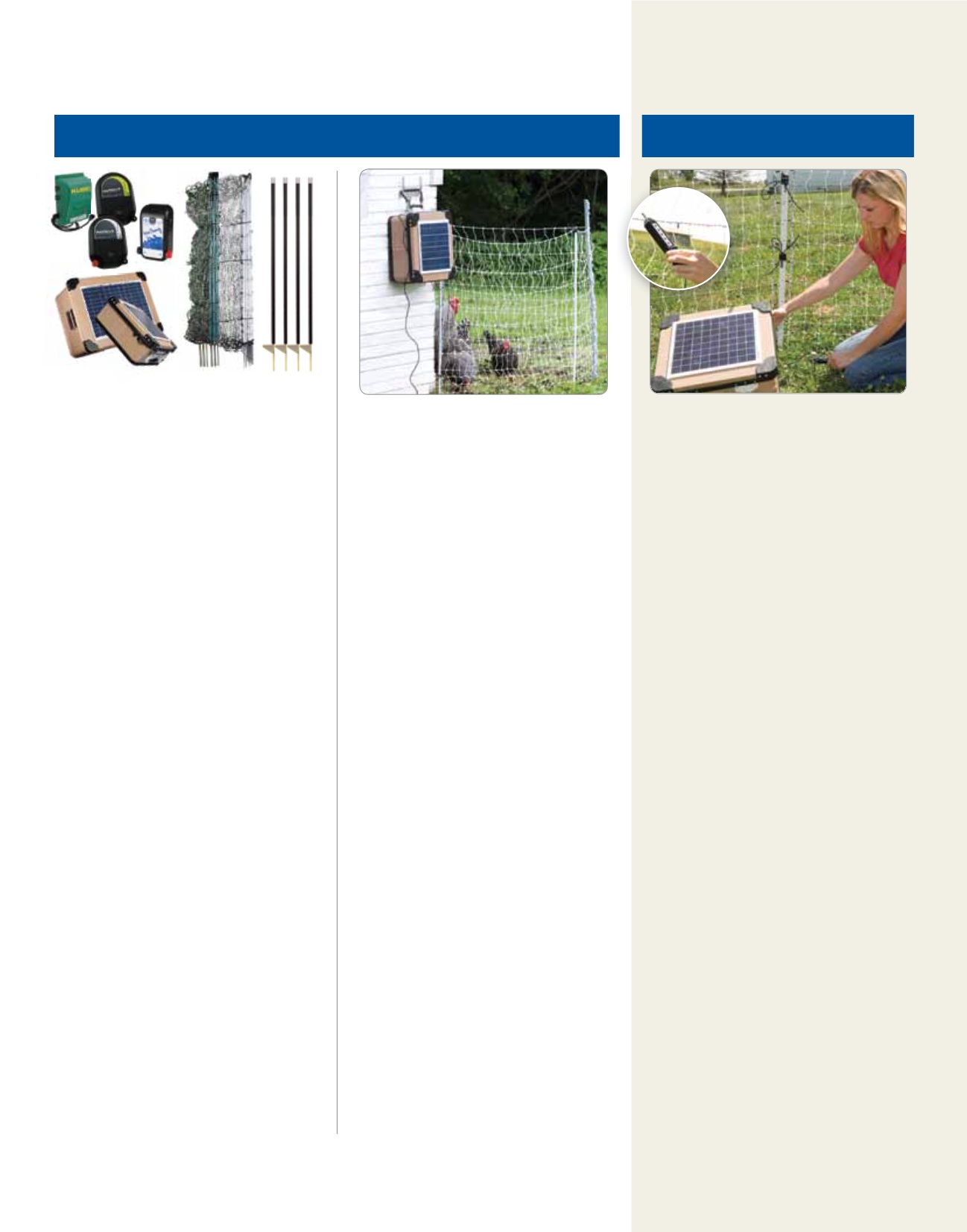
(see inset above)
reads more than 4000v, the energizer
is working properly and something
is not as it should be with the fence.
Check fence for contact with the soil
or weeds.
If you continue to have issues, call
Premier
(see p. 4 for information)
.
Q. Some of my netting wires are being
chewed or cut. Why?
A.
The lower wires are not “hot” enough
to prevent small animals (rats, mice,
rabbits) from cutting them with their
sharp teeth.
Q. How do I fix a break in my net?
A.
Each net is equipped with a repair kit
containing brass ferrules, conductive
twine, post tops and bottom clips. Use
a fisherman’s knot to re-tie the broken
strand. Clamp brass ferrules over the
knot to hold it in place.
Q. How do I put in replacement posts?
A.
Start at the bottom of the net and
interweave the new post upwards.
Once done, place the lowest all-black
strand in the replacement bottom clip
and slide it up the steel ground spike.
Then attach the top strand to the cap
on top of post.
Q. Does net have to be electrified?
A.
Yes. Always. It’s a serious mistake to
not electrify it.
Why?
1. Nonelectrified netting increases
risk of entanglement and death.
2. Netting that isn’t electrified will
not stop predators.
3. Poultry/waterfowl will peck and
chew netting that isn’t electrified.
Conclusion: A simple quick shock is
better than death by entanglement or by
a predator.
Q. What about grass contact?
A.
Too much is a serious problem as it
lowers the voltage of the fence. So:
1. When grass gets 6" high, turn
off the energizer. Mow along the
fence. If you mow into the fence,
then your wallet, the mower and
the net will all regret it! Move
the net into the mowed strip by
removing and reinstalling it 1 post
at a time. Turn the energizer on.
2. Or spray herbicide in a narrow
strip under the fence. We prefer
burn-down options that don’t
kill perennial vegetation. The
vegetation will return in time.
3. Buy an energizer large enough to
cope with extra weed contact.
Q. What’s the best energizer?
A.
For poultry and poultry netting, low
output units (the cheaper ones sold
by stores and some catalogs) almost
always disappoint.
Recommended energizer kits can
be found on pp. 52–53.
Troubleshooting
Face solar energizers to the south. This offers the
most available sunlight to recharge the batteries.
After turning on the energizer, test the fence
with a voltmeter. Voltage should be at least 3000v.
Netting, Energizer Kits and Electrification
Q. Why do you sell netting and
energizers as kits?
A.
To simplify purchasing decisions—
because there are so many netting
options, support post choices, etc.,
and because it’s complicated for those
without experience to buy components.
We also know that:
1. Many already own an energizer.
If you’re not sure whether it will
work for our fences, call us.
2. Many need longer fences and
larger energizers than suggested
in our kits. If so, call us and we will
help you reach a solution.
3. Check out the “How to” videos on
our website’s home page.
Q. Fence energizers? Why and which
one to choose?
A.
For netting to be effective, it absolutely
must be electrified.
Many cheap
energizers are too low in energy output
to properly energize a roll of netting
.
That is why we offer our own units—
specifically selected for the purpose.
Q. Which energizer is right for you?
A.
If you’re close enough to plug the
energizer into an outlet, always use a
plug-in (AC/110V) unit.
For fences far away from an outlet,
your choices are:
a. DC battery, for which you will
need a 12 volt battery that must be
regularly recharged.
b. PRS solar units—an all-in-one kit.
Units are ready to work within
5 minutes.
Just place it, drive in the ground
rod, connect the leads, switch it on
and test for voltage on the fence.
Potential kit options for netting and energizers.