



 38 / 56

38
www.premier1supplies.com • 1-800-282-6631Q. How does netting work in winter?
A.
It’s not easy to move in winter because
the posts freeze into the soil.
• If we need to remove a post, we
clamp pliers on the steel spike and
twist it each way to loosen.
• To install posts into frozen soil, use a
battery drill to make pilot holes.
• Heavy ice and snow can flatten
netting. They also can reduce the
ability for the pulse to pass through
the bird/animal and into the ground.
On the other hand, poultry are
rarely outside in wintry conditions.
Q. Is the bottom strand “live”?
A.
No.
Q. How can I make my netting work
better in dry weather?
A.
Four options:
1. Purchase a wide impedance
energizer. They are more capable
of pushing strong electric pulses
through dry soil than low
impedance units.
2. Install more or longer ground rods.
The extra length should reach the
damp subsoil.
3. Place the energizer’s ground rod
where the soil will remain damp.
4. Moisten the soil around the
energizer’s ground rod. To do this,
make a pencil-sized hole in the
bottom of a 3 to 5 gal bucket. Set
the bucket next to the ground rod.
Fill the bucket with water. The
water will gradually seep into the
soil around the ground rod. Refill it
every few days.
Birds/Animals
Q. How much area do I need to fence
in my poultry?
A.
Depends on size of bird, type of
production, climate and producer.
The numbers below are minimum
recommendations (per bird) for
outdoor poultry pens. Within limits
more space is always better.
• Standard breeds: 8 sq ft
• Bantams: 4 sq ft
• Ducks: 15 sq ft
• Geese and turkeys: 18 sq ft
Q. Will netting harm the birds
or other animals?
A.
Not unless they are unable to move
away from it. An electric fence pulse
lasts less than 3 milliseconds—which
is too brief to cause harm if contact
does not repeat.
Q. I want to contain several species.
Which fence design is the best?
A.
Choose the fence for the most difficult
species to contain. For example, if
fencing both poultry and sheep or
goats, use either PoultryNet 12/48/3 or
PermaNet 12/48/3.
Q. Can predators jump the net?
A.
It is certainly possible for some
predators to jump fences. However,
this is unlikely if the net is properly
electrified when it is first set up and
always maintained that way.
Why? Because of the “fear factor”
created by a shock from a serious
fence energizer. Our sheep guard
dogs will jump or climb ordinary 4 ft
tall wire fences and gates in pursuit of
coyotes or other dogs. But they won’t
jump 35" tall electrified fences.
Q. Does the net have to make a
complete circle?
A.
No. We have many nets in use on
our farms that are in a straight line
between corners of buildings or other
end points.
Q. How do I support it at corners?
A.
Two options:
1. Install a strong nonconductive
support post
(FiberTuff, p. 50.)
2. Drive a tent peg or steel T post
outside the fence’s corner at least
2" away. Tie the netting post to this
with nonconductive string or rope.
Q. How do I hook 2 rolls of net
together electrically?
A.
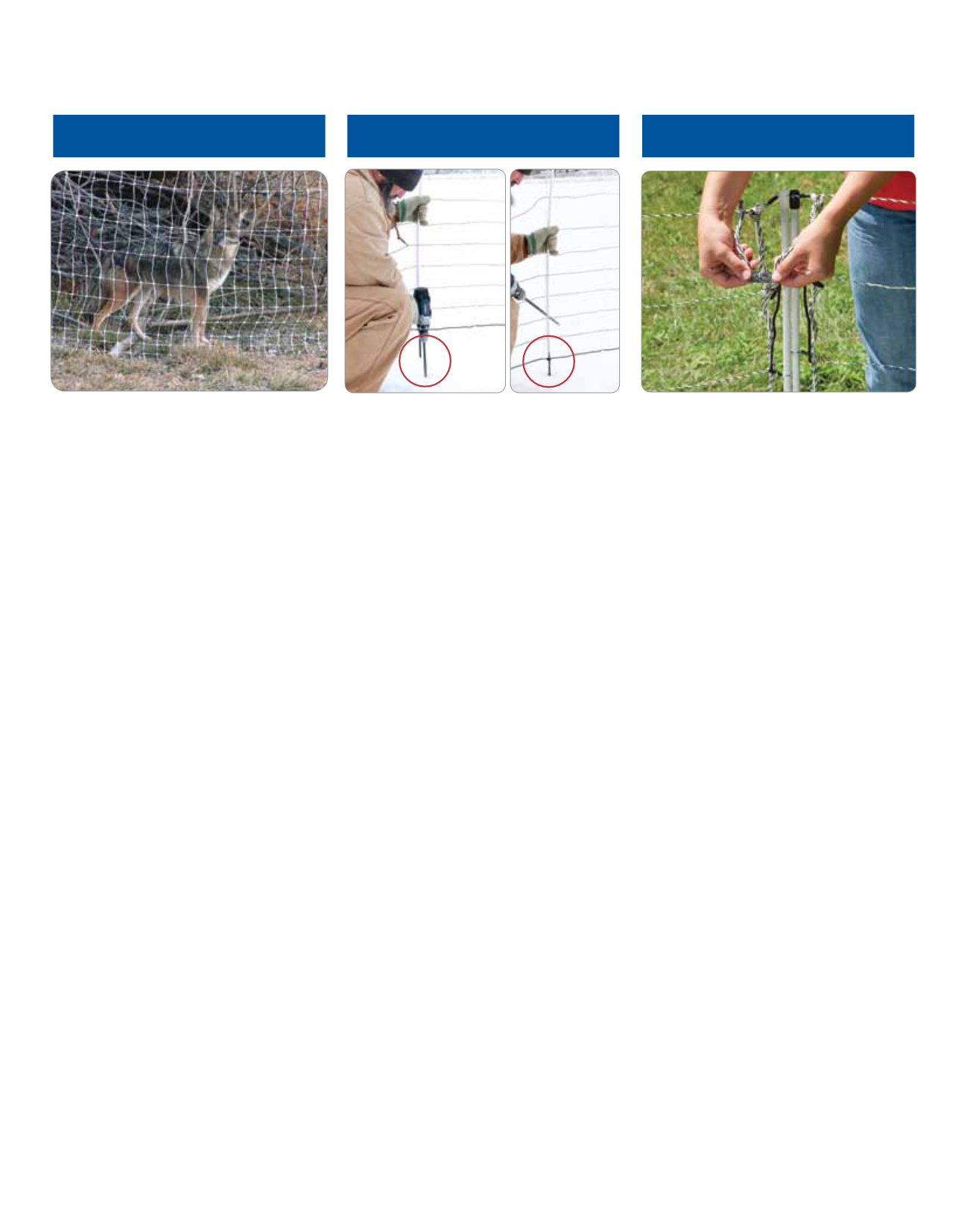
There is a stainless steel clip
(see
photo above)
on each end of all nets.
Just join the clips together by hand to
electrically connect the 2 rolls of net.
Q. Can I use different types or styles
of netting together?
A.
Yes. They all conduct electricity—but
some do so much better than others.
Q. What if the net is too long?
Can I cut it?
A.
We strongly advise against cutting
netting—because all the energized
horizontal strands are interconnected
at each end of the net.
The best way to deal with net that is
too long is to make a complete U-turn
with the excess netting and erect it
back alongside the original fence line.
The 2 nets can touch one another.
Installation
Drill pilot
hole(s)
Insert
post(s)
Climates/Regions
Coyotes are one of many pests that well-energized
netting will stop. Photo by Kathleen Gustafson, MO.
When connecting 2 rolls of netting, slip together the
stainless steel clips located at the top of the end posts.
When the soil is frozen, drill pilot holes for the metal
spikes. They will insert much easier.
Netting FAQs